Sunday, 6 March 2011

mini cooper cars picturs n wallpapers

CooperS Classic Car Design And development as project ADO15 (Austin Drawing Office project number 15), the Mini came about because of a fuel shortage caused by the 1956 Suez Crisis. Petrol was once again rationed in the UK, sales of large cars slumped, the market for German Bubble cars boomed. Leonard Lord, the somewhat autocratic head of BMC, reportedly decreed: 'God damn these bloody awful Bubble Cars. We must drive them off the road by designing a proper miniature car'. He laid down some basic design requirements: the car should be contained within a box that measured 10 × 4 × 4 ft (3 × 1.2 × 1.2 m); and the passenger accommodation should occupy 6 ft (1.8 m) of the 10 ft (3 m) length; and the engine, for reasons of cost, should be an existing unit. Issigonis, who had been working for Alvis, had been recruited back to BMC in 1955 and, with his skills in designing small cars, was a natural for the task. The team that designed the Mini was remarkably small: as well as Issigonis, there was Jack Daniels (who had worked with him on the Morris Minor), Chris Kingham (who had been with him at Alvis), two engineering students and four draughtsmen. Together, by October 1957, they had designed and built the original prototype, which was affectionately named "The Orange Box" because of its colour.

The ADO15 used a conventional BMC A-Series four-cylinder water-cooled engine, but departed from tradition by mounting it transversely, with the engine-oil-lubricated, four-speed transmission in the sump, and by employing front-wheel drive. Almost all small front-wheel-drive cars developed since have used a similar configuration, except with the transmission usually separately enclosed rather than using the engine oil. The radiator was mounted at the left side of the car so that the engine-mounted fan could be retained, but with reversed pitch so that it blew air into the natural low pressure area under the front wing. This location saved precious vehicle length, but had the disadvantage of feeding the radiator with air that had been heated by passing over the engine. It also exposed the entire ignition system to the direct ingress of rainwater through the grille.

mini cooper
mini cooper
mini cooper
mini cooper
mini cooper
mini cooper
mini cooper
mini cooper


Mercedes-Benz Cars Info & Images

Mercedes-Benz is a German manufacturer of automobiles, buses, coaches, and trucks. Mercedes-Benz is a division of its parent company, Daimler AG. Mercedes-Benz traces its origins to Karl Benz's creation of the first petrol-powered car, the Benz Patent Motorwagen, patented in January of 1886[1] and Gottlieb Daimler and engineer Wilhelm Maybach's conversion of a stagecoach by the addition of a petrol engine later that year. The Mercedes automobile was first marketed in 1901 by Daimler Motoren Gesellschaft. The first Mercedes-Benz brand name vehicles were produced in 1926, following the merger of Karl Benz's and Gottlieb Daimler's companies into the Daimler-Benz company.[1] Mercedes-Benz has introduced many technological and safety innovations that later became common in other vehicles.[2] Mercedes-Benz is one of the most well-known and established automotive brands in the world, and is also the world's oldest automotive brand still in existence today.

Mercedes-Benz Image
Mercedes-Benz Wallpaper
Expensive Mercedes-Benz
Mercedes-Benz Gallery
Mercedes-Benz Pic

Tuesday, 1 March 2011

Gemballa Mirage Wallpapers & Info

Porsche Carrera GT, one of the finest sports supercars, had a limited series production of roughly 1380 models. Owners of these completely sold-out vehicles, GEMBALLA gives the chance to top this exclusiveness. The Porsche customizing specialists of Leonberg, Germany transforms the Carrera GT into the GEMBALLA Mirage GT; offered in an extremly limited series of only 25 models. More than half of this series is already sold. Customers including several prominent ones, place their trust in the technical expertise of GEMBALLA assuring unquestionable singular uniqueness of their Mirage GT.

One thing is quite certain; a Mirage GT driver will find no better individualization anywhere. But GEMBALLA not only offers its Carrera GT-conversion on an extremely limited scale of 25 exemplars. Over and above this, every Mirage GT looks different. First of all, this is because no vehicle comes in the same colour. GEMBALLA here of course follows individual customer preferences. A well-known professional soccer player, for example, chose black with extravagant glitter finish. Secondly, the Mirage GT’s interior is uniquely distinguished as well. GEMBALLA made certain that the interior components such as carbon parts and leather are always furnished in different varied combinations. Eleven Mirage GTs have already been customized by GEMBALLA. Further vehicles are currently under modification. Those who would like to order and savour the exclusivity of a high-tech products, must hurry!

The Carrera GT engine is a dream. A meaty 5.7-litre V10 boasting 612 horsepower. What more could one want? More power of course! GEMBALLA operates on the same principle as racing drivers: “You can never have too much power”. By modifying the engine management electronics, GEMBALLA has been able to squeeze out a further 40 bhp of power and 20 Nm more torque for the V10, slicing off 0.1 seconds off the time it takes to go from 0 to 100 km/h. The fully stainless steel exhaust system now resounds through four tail pipes instead of the standard two. GEMBALLA has positioned the two extra tail pipes where the reverse and fog warning lamps used to be. The tuning specialist has relocated the two lamps to beneath the rear diffuser.

With the GEMBALLA AERO-CONCEPT, the Mirage GT looks like it is planning to enter the Le Mans 24-hour race. The most conspicuous change to the front are the additional air intakes on the new front spoiler. In addition, GEMBALLA embellished the component with a spoiler lip. The bonnet has also been replaced. In the area between the wheel housing and door GEMBALLA has replaced the standard side panels with its own mudguards, with reshaped openings which blend harmoniously with the original design. Down below, new side skirts lend the vehicle a muscular line. They also come with a cooling vent for the breaks at the rear. One thing is certain! The racing look is enhanced by the new rear skirt, with its aerodynamically optimised mid section for more downforce on the rear axle. GEMBALLA´s AERO-CONCEPT considerably increases the air stream through the car´s body, which is the pre-condition for the cooling of the next power upgrade to 800 hp currently being in preparation.

The lion’s share of the extra downforce over the production-line vehicle is due to the mighty GEMBALLA rear wing that adorns the rear of the car. It comes with an electronically controlled flap in the middle, which snaps up at speeds of up to 120 km/h to increase downforce in curves and integrates itself again smoothly into the rear wing structure above 120 km/h. The increase in downforce is approx. 30 kg at the front axle and up to 85 kg at the rear axle. The roof line of the GEMBALLA Mirage GT also starkly differs from the standard Carrera GT. The front section of an airbox has been integrated into the new GEMBALLA hardtop. This ends in an air duct that runs along the back of the tailgate installed by GEMBALLA and supplies the power-enhanced V10-engine with more air to breathe.

With the GEMBALLA AERO CONCEPT, the Mirage GT fits perfectly into the starting line-up of any FIA-GT race. Not least also because of the materials used by GEMBALLA – all parts of the body of the Mirage GT are made of carbon fibre; a material common in the world of racing.

Gemballa Mirage
Gemballa Mirage
Gemballa Mirage

Gemballa Mirage Video
Gemballa Mirage
Gemballa Mirage
Gemballa Mirage
Gemballa Mirage Wallpaper
Gemballa Mirage
Gemballa Mirage

Chevrolet Cobalt SS Review & Pictures

The Cobalt SS is a line of three sport compact versions of the Chevrolet Cobalt built on the General Motors Delta platform at Lordstown Assembly in Ohio, United States. Featuring two boosted and intercooled inline-4 Ecotec engines, as well as a third naturally-aspirated engine, the line was GM's first foray into the tuner market.

The car launched with a 205 hp (153 kW) supercharged 2.0 L engine in late 2004 as a 2005 model, paired with the F35 Manual transmission of GM Europe. The following year, a naturally-aspirated 1SS model equipped with GM's new 2.4 L,171 hp (128 kW) engine was added; it had both automatic and manual transmission options. After three model years the supercharged car was discontinued, but a second 2.0 L engine exclusively mated to the F35, with power upped to 260 hp (194 kW) by way of a turbocharger, revived the Cobalt SS in the second quarter of 2008 (See timeline).

The powertrain of the Cobalt SS received generally positive reviews, especially the turbocharged version, but the car was criticized for poor interior quality and exterior styling that was too reminiscent of its predecessor, the Cavalier. Reports surfaced in May 2009 that General Motors planned to eliminate the Cobalt SS as soon as December 2009, but they proved to be untrue. Production continued, but ordering options for late 2010 models were limited, and production of all Cobalts ended in June 2010. The car has been replaced by the European-developed and Korean-designed Cruze, but a high performance version to directly replace the Cobalt SS has not yet been announced, nor any possible powertrains.

Chevrolet Cobalt SS Pics
Chevrolet Cobalt SS Photo
Chevrolet Cobalt SS Gallery
Chevrolet Cobalt SS Picture
Chevrolet Cobalt SS Wallpaper
Chevrolet Cobalt SS Image

Chevrolet Cobalt SS Performance Video

Thursday, 24 February 2011

Subaru Cars Images

Subaru is the automobile manufacturing division of Japanese transportation conglomerate Fuji Heavy Industries (FHI).

Subaru is internationally known for their use of boxer engines in most of their vehicles above 1500cc as well as their use of the all wheel drive drivetrain layout, first introduced in 1972, that became standard equipment for mid-size and smaller cars in most international markets as of 1996. They also offer many turbocharged versions of their passenger cars, such as the Impreza WRX.

Fuji Heavy Industries, the parent company of Subaru, is currently in a partial partnership with Toyota Motor Corporation, which owns 16.5% of FHI.

Subaru is the Japanese name for the Pleiades star cluster, which in turn inspires the Subaru logo and alludes to the six companies that merged to create FHI.

Subaru car
Subaru car
Subaru car
Subaru car
Subaru car
Subaru car
Subaru car
Subaru car
Subaru car

Wednesday, 23 February 2011

bmw m3 2010

Bmw M3 wallpaper full body chrome with Photoshop work

Bmw M3 wallpaper full body chrome

Bmw M3

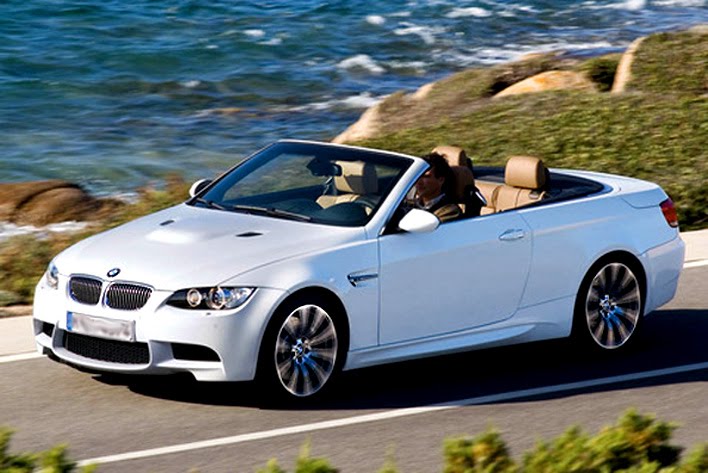
The new 2010 Bmw M 3. Beautiful white convertible car


Bmw M3 coupe wallpaper 2009
Bmw M3 coupe


Bmw M3 Review

Throughout its two decades on the U.S. market, the BMW M3 has been a favorite of enthusiasts looking for sports-car performance and handling from a true four-place car. Although content to smoothly burble around while doing daily driver duty, the BMW M3 transforms into a back-road burner when conditions allow and gives its pilot the opportunity to attack corners with precision and rocket out of them with gusto.

Current BMW M3

Based on the present-generation BMW M3 Series, the BMW M3 is offered in only one trim level among the coupe, sedan and hardtop convertible body styles. Each is powered by a 4.0-liter V8, good for 414 horsepower and 295 pound-feet of torque, which revs to a thrilling 8,400-rpm redline. A six-speed manual is the standard means of sending power to the rear wheels, and a seven-speed automated-clutch manual gearbox with paddle shifters is optional. BMW M3 also get specific hardware upgrades such as more powerful brakes, stiffer suspension tuning and a specialized limited-slip rear differential.

Like previous BMW M3, the current BMW M3 model comes well-equipped with the latest luxury amenities, which in this case includes xenon headlamps, leather upholstery, heated power sport seats and a 10-speaker audio system. The convertible features a nifty hardtop and sun-reflective leather. Features like 19-inch wheels, heated seats, satellite radio, the iDrive navigation system and BMW M3 Sport personalized performance settings are optional.

While past BMW M3 have been performance stars, the new BMW M3 coupe is quite simply one of the best cars to grace our test track. It accelerated from zero to 60 mph in a blistering 4.6 seconds and came to a stop from 60 mph in an extremely short 100 feet. The slalom and skid pad test results were also on par with vastly more expensive supercars, while on-road handling is beyond reproach. Regardless of which body style you choose, expect one of the best performance machines money can buy.

Used BMW M3 Models

The present-generation BMW M3 was introduced for 2008. The following year, BMW upgraded the iDrive system and freshened the M3 sedan's styling slightly.

The previous BMW M3 lasted from 2001-'06 and was available in coupe and convertible body styles. There was a single trim level for both, powered by a 3.2-liter six-cylinder engine producing 333 hp and 262 lb-ft of torque. A six-speed manual transmission was standard, while a six-speed sequential manual gearbox (SMG) was offered as an option starting for the 2002 model year. The latter allows manual-style shifting via paddle shifters next to the steering wheel, and although it was popular, we weren't fans of its herky-jerky performance.

Monday, 21 February 2011

BMW 330D Pictures

It’s no secret that the 3-Series is BMW’s most important car. Around 32,000 saloon and Touring models are bought
here each year, which puts the model ahead of the Ford Mondeo in the sales charts. But with increasing competition, led by the Audi A4, the 3-Series is under pressure, so it has gone under the knife to ensure it stays ahead of the game.The success of the existing model means styling tweaks have been kept to a minimum. Still, the company’s designers have been hard at work improving the facelifted car.

The car is wider to provide greater stability and even better handling, while the front bumper now features more sculpted, upturned air intakes. These draw attention to the greater girth, and a big, horizontal band does the same job on the rear bumper.There’s also a new bonnet, which has two sharp lines running from the badge to the hood’s trailing edge. And the side sills are sharply creased, giving the impression that the 3-Series is longer than before.There are new light clusters, too. Up front are twin-halo daytime running lamps that mirror those seen on the larger 5-Series. Both front and rear clusters also benefit from LED indicators, which are brighter and more attractive.Inside, it’s a similar story of refining the package. The cabin is more practical, while new materials improve the air of quality. But the biggest change is to the much-maligned iDrive control system. The new set-up uses a hard drive, rather than being DVD-based, so it works much faster. Plus, the controller is upgraded, while the screen is now bigger and more colourful.A number of useful functions have been added, such as the ability to save your MP3 digital music files on to the system and the optional ConnectedDrive Internet access. The 3D sat-nav works well, too. But best of all, iDrive is more intuitive, so it’s nowhere near as frustrating to master as it once was.

We drove the 330d, which has an all-new version of the six-cylinder 3.0-litre turbodiesel. This engine is 5kg lighter than before, and although it delivers an extra 14bhp and 20Nm of torque – at 245bhp and 520Nm respectively – it’s seven per cent more fuel efficient. That means it returns 49.6mpg combined, thanks in part to the improved EfficientDynamics system, which includes stop-start technology.On the road, the powerplant is fairly vocal, and while it’s not as tuneful as the 3.0-litre petrol, it sounds pleasant. It certainly has plenty of power, with the traction control being triggered under modest acceleration on damp roads. Most impressive is the unit’s flexibility at any speed, making town driving as effortless as overtaking on the motorway.The steering is lighter, but still direct, and the wider track means handling remains strong. So the tweaks keep the 3-Series at the top of the tree for drivers wanting practicality and pace, especially with this impressive new diesel. But bosses predict the 320d, which has an equally strong engine at a lower price, will account for half of all sales.

Article Source:autoexpress.co.ukBMW 330D
BMW 330D
BMW 330D
BMW 330D
BMW 330D
BMW 330D

Australians are finally coming around to the diesel revolution. We’re realising that the relaxed, torquey nature of compression ignition sits well with not just our speed limits and driving styles, but also our hip pockets.
But does it work in a convertible? Many car companies have hedged their bets, and are now releasing diesel drop-tops. BMW’s 330d on test this week proves that the two can merge to create a stunning combination. Indeed, once you’ve driven it, you may not ever look at the petrol model 3 Series Convertibles.If you are looking to the blue-and-white propeller, then chances are you’re after a four seater convertible which actually has rear leg space and driver involvement. After all, it’s a step up from its competitors: the Lexus IS250C looks decided awkward with the roof up, the Mercedes-Benz E-Class Cabriolet is a soft-top, as is Audi’s A5 Cabriolet, both of which don’t give the ultimate driving involvement that the 330d offers. Then there’s the Volvo C70, which is a great looking car, but it’s front wheel drive and overall it is a bit soft; certainly you can’t punt it like you can the Beemer.But there’s something else that the BMW offers; the Efficient Dynamics program means fuel use stays low, but driving fun stays high. The catalyst for ensuring these two criteria were met was the turbo-charged, 3-litre, six-cylinder diesel engine under the bonnet.You can’t help but be impressed by this engine.

It’s almost inconceivable that a few years ago we’d be calling a diesel engine a sweet, free-revving unit, but here we are – and we’re saying it. Plenty of torque is almost expected; it is an oil-burner after all, but it’s the colossal amount that makes your eyes pop. At 520 Newton-metres, it makes the 330d feel like it’s a big, lazy V8, and even though the on-paper specs tell us that it peaks from 1750rpm, it comes in extremely strong at a tick over 1200rpm, meaning effortless surge.Power is also intoxicatingly impressive, with 180kW happening right at the top end, meaning there’s no letup in acceleration. Ever. Well, that is until you hit the speed limiter at 250km/h, but we’re not going to be doing that in Australia, are we? Let’s just remind ourselves of that power figure again. One-hundred-and-eighty-kilowatts. From a three litre diesel. The 0-100km/h sprint in just 6.5 seconds tells the tale, but rolling acceleration is the most impressive; you’ll be slowing down, just to overtake something and feel that tidal-wave of torque shove you in the back.

And despite thoroughly enjoying ourselves behind the wheel (read: hammering it on occasion…well, actually, quite a lot) fuel consumption refused to go above 8.1-litres/100km. Staggering.

source:caradvice.com.au